
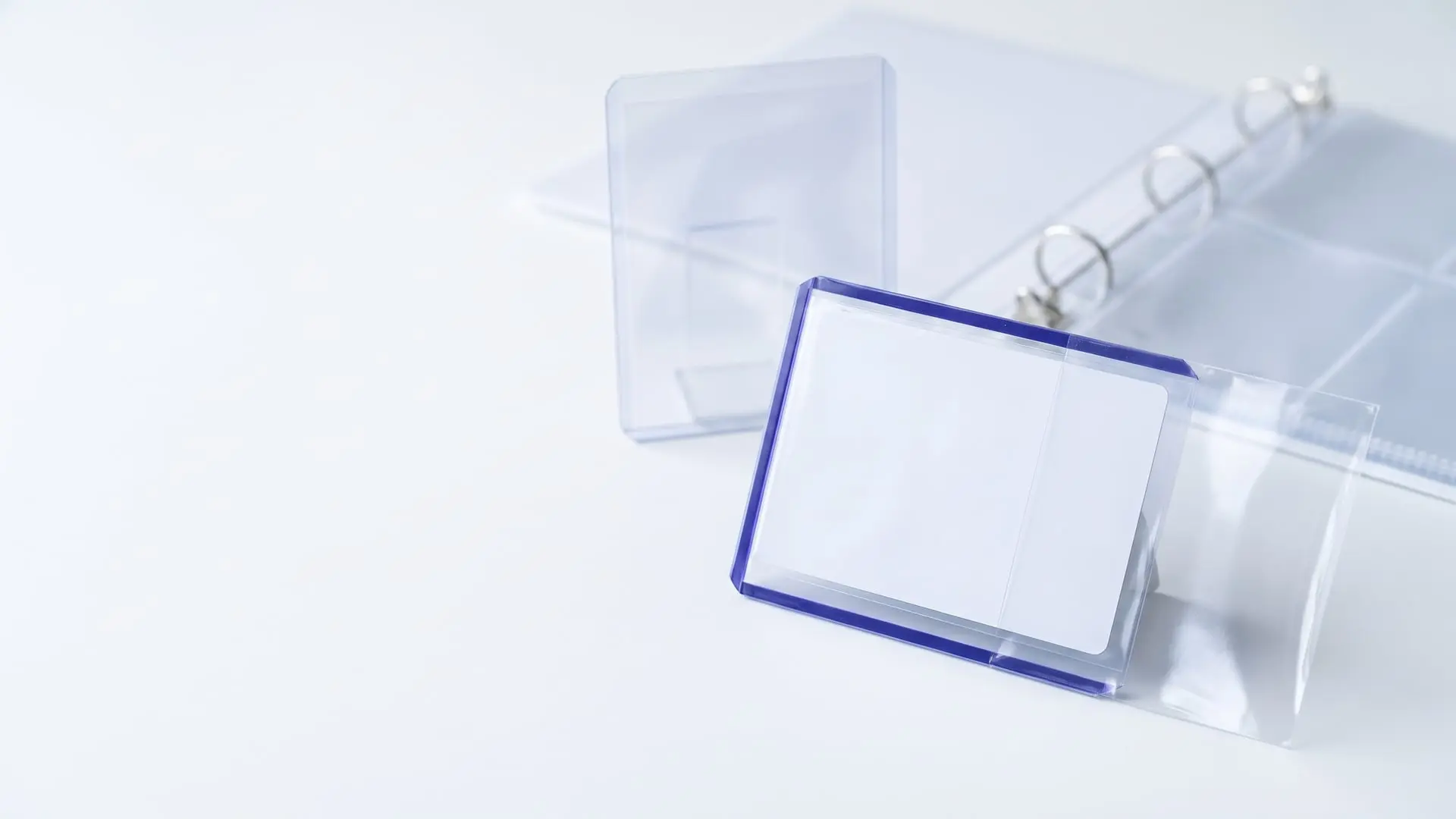
To protect Pokémon cards, or any trading cards, sort every card into one of three groups (the cards you play with, the cards you keep, and the few that are worth something) and give each group its own protection: a sleeve, a binder pocket, or a sleeve plus a rigid holder. That covers almost every new collection, and it is cheap, because most cards need very little. Most real damage comes from two habits that cost nothing to avoid: rubber bands or paper clips, and heat, sun or damp.
The three-group rule
Ask one question per card: would you be upset if it bent?
- Play cards (the deck you shuffle every week): no, as long as the deck works. They need a sleeve and a deck box.
- Keep cards (the collection you like looking at): a bit. They go into a binder.
- Valuable cards (the handful you'd really mind losing): yes. They get a sleeve and a rigid holder.
Most of a new collection is in the first two groups. If you're a parent with a child who just opened their first packs, the valuable group may be empty for months, and that's fine.
Two mistakes that ruin cards
- Rubber bands and paper clips. A rubber band squeezes the top and bottom cards of a stack and leaves a permanent dent; a paper clip bends a corner in seconds. A small box or a deck box does the same job without the damage.
- Heat, sun and damp. Cards are printed card stock. A car in summer, a sunny windowsill or a damp cellar can warp, fade or curl them. Keep collections indoors, dry and out of direct light.
Sleeves: which kind, and which size
Sleeves come in three kinds:
- Thin clear sleeves, often called "penny sleeves": cheap, for storing and as the first layer under a rigid holder. Not made for shuffling.
- Playing sleeves: thicker, often with a coloured back, made to be shuffled hundreds of times.
- Inner sleeves ("perfect fit"): a tight sleeve that goes on first, with a playing sleeve over it. That's called double-sleeving.
Card games come in two sizes:
- Standard size, cards of about 63 × 88 mm: Pokémon, Magic: The Gathering, Disney Lorcana and Flesh and Blood, and most Western card games, according to one sleeve maker.
- Japanese or small size, cards of about 59 × 86 mm: Yu-Gi-Oh!, Cardfight!! Vanguard and other Japanese-format games (size chart).
The numbers on the pack can mislead. Some makers print the size of the card the sleeve fits, others the size of the sleeve itself: another manufacturer lists its standard sleeves as 66 × 91 mm and its small ones as 62 × 89 mm. Both are right; they measure different things.
For any other game, take one card to the store and try a sleeve on it before you buy a pack of 100.
A Yu-Gi-Oh! card in a standard sleeve slides around, and a Pokémon card won't go into a small one.
Toploaders and semi-rigid holders
A toploader is a stiff clear plastic holder with an open top. The common size for standard cards is 3 × 4 inches; one maker sizes it for cards of 63.5 × 88.9 mm up to 35 pt thick (product page).
- Put the card in a thin sleeve first, then slide it into the toploader. The sleeve keeps the edges from scraping on the hard plastic.
- Semi-rigid holders are thinner and flex slightly: a lighter alternative to a toploader, with the same rule of sleeving first.
- Magnetic cases are thick two-part cases for display. They make sense for the one card you put on a shelf, not for a whole folder.
Binders that don't damage cards
A binder is the best home for the "keep" group, if it's the right kind:
- Side-loading pockets: cards go in from the side, so they can't slide out when the page is upright.
- Bound pages rather than rings: in a ring binder, the cards closest to the rings can get pressed or dented when the binder closes. A binder with fixed pages avoids that.
- Choose pages labelled acid-free and PVC-free; that's what sleeve and binder makers advertise for long-term storage.
- 9 or 4 pockets per page: nine pockets fit more cards per page; four-pocket binders are smaller and easier for children to handle.
Don't overfill a binder: one card per pocket, or two back to back at most, so the pages lie flat.
Boxes for everything else
- Deck boxes hold one sleeved play deck, so it doesn't get scuffed in a bag.
- Storage boxes hold everything you don't need often: the duplicates and commons that make up most of every pack.
If you play at tournaments
Events have their own sleeve rules. The One Piece Card Game's tournament rules, for example, require sleeves at events, ask for opaque, identical sleeves in the main deck, and allow up to two sleeves per card. Check the rules of your game before your first event; if One Piece is your game, the OP-18 release event runs until 17 December (our guide).
A starter kit for a new collector
- For the play deck: one pack of playing sleeves in the right size and one deck box.
- For the keep cards: one side-loading binder with fixed pages.
- For valuable cards: a few thin sleeves and a few toploaders.
- For the rest: a simple storage box.
Take a card to your local store and try the sleeves there. On Boardoro, 26 places in the EU and the UK say on their page that they sell single cards too, 22 of them in Germany. Find one near you, or see which card games Europe's stores list in our card game overview.
Drafted with AI assistance and checked by the editor before publication. How we report.